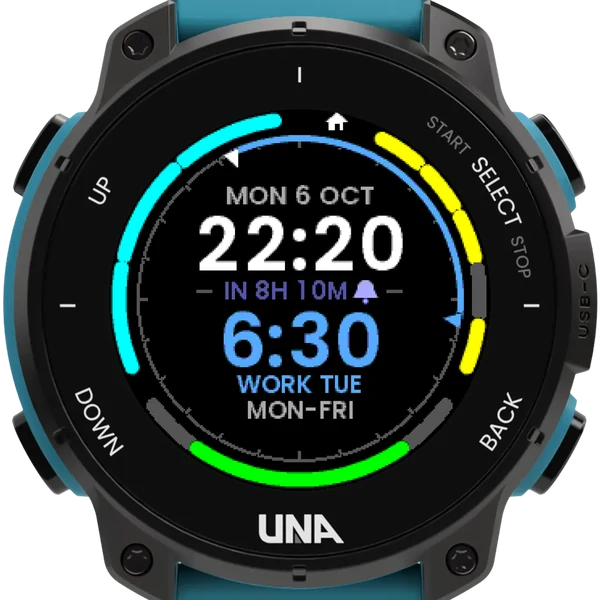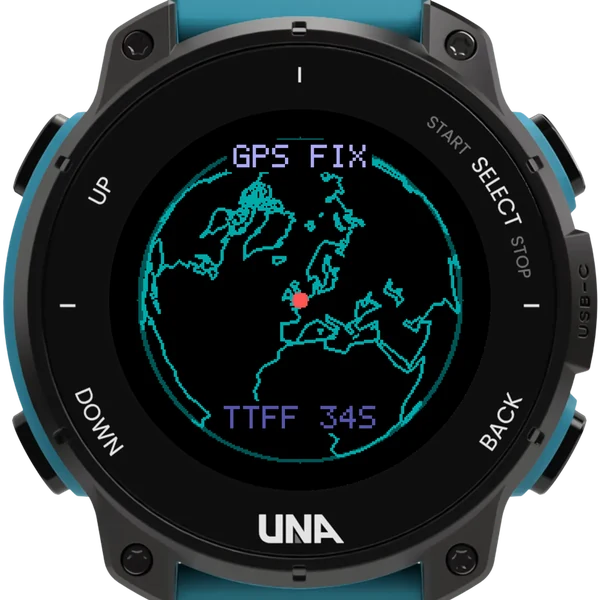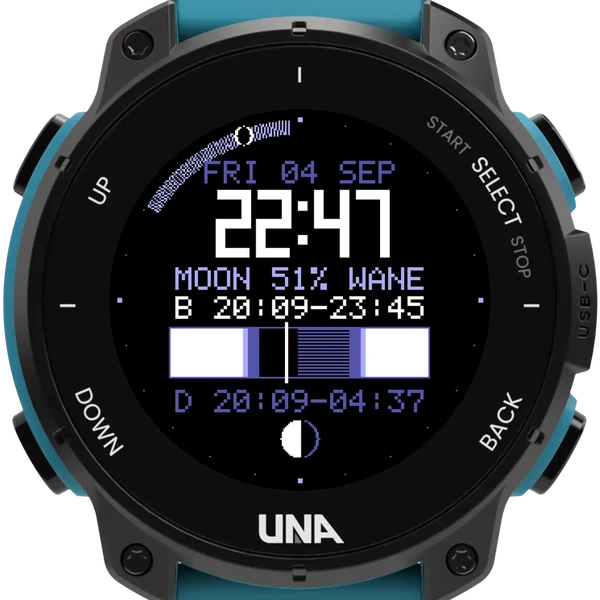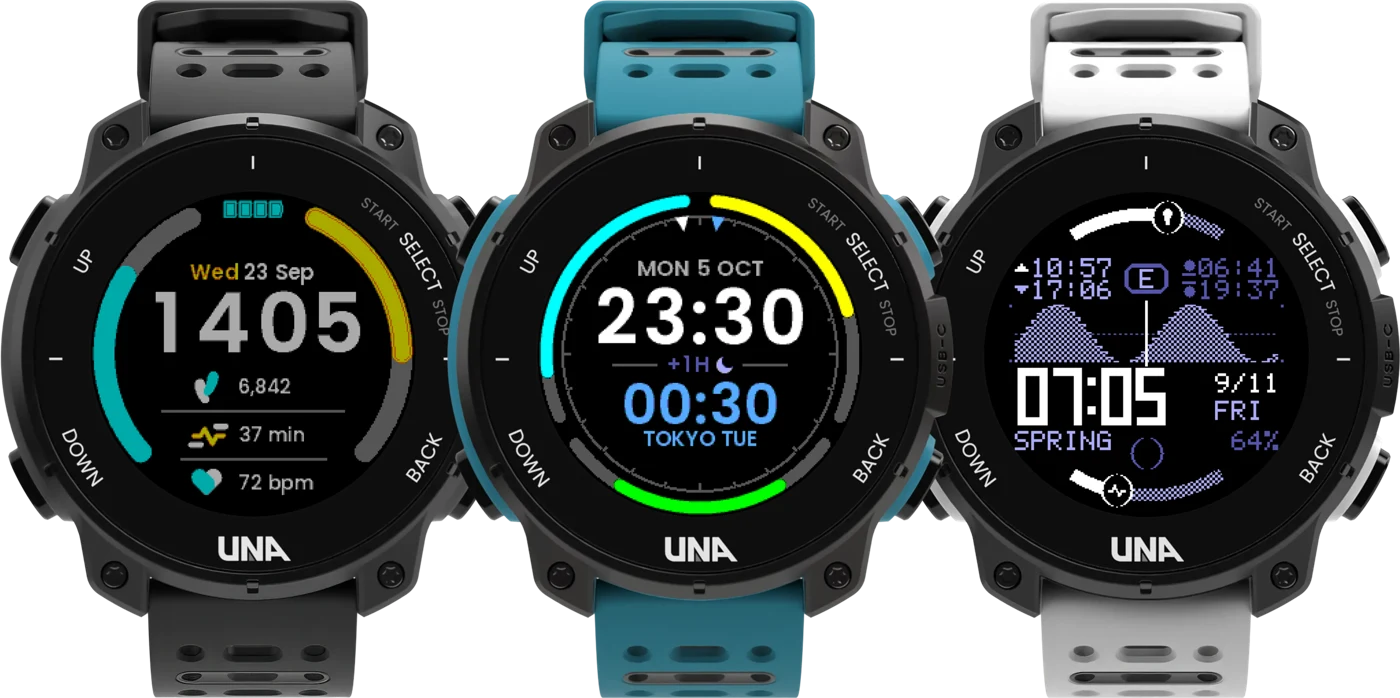
The four kinds of app, and how to tell a utility from a watch face: which kind of app?
What makes it worth a look
Open down to the circuit boards
UNA publishes its software kit under the MIT licence, and the design files for all six of the watch's boards, schematics and parts lists included, with the case's 3D files, under CC BY 4.0: in UNA's words, "enabling users to debug their own hardware."
Real sensors on the wrist
GPS from an Airoha AG3335M receiver, a barometric altimeter, a magnetometer for a compass, an optical heart-rate sensor, and motion sensors an app can read a hundred times a second.
Apps that run as native code
Apps are C++ running directly on the watch's ARM chip, each a background service with a screen of its own: an alarm rings with its app closed, a track records with the screen dark.
Made to be built for
Free tools on Linux, macOS or Windows, a simulator, TouchGFX or LVGL for the screen, unit tests on the computer, a Figma kit, and fourteen example apps and nine tutorials in UNA's documentation.
A round screen and four buttons
A round 240 by 240 colour display, driven by four buttons rather than touch: up, down, select and back.
Your data, as files
Plugged into a computer it is a drive: an app installs by copying a file, and what apps record, a GPS track for one, copies off the same way. Apps are set up from the phone.
What we have measured
- The display is reflective and always on, and reads in daylight without its light.
- 31 of the 38 sensor types delivering data on firmware 1.5.0-rc4, swept with SensorView.
- Motion at 94 to 102 samples a second against the 100 asked for.
- Heart rate matching a finger-worn optical reader at 61 bpm, side by side.
- GPS at about 9% of the battery an hour with a fix every second: roughly ten hours of tracking from full.
- A new app reviewed and approved by UNA within about ten hours of submission.
FossIsTheWay's own measurements on its own watch, with its own apps; the rest of this page is from UNA's documentation, its SDK and its hardware repository.
Where to find more
- UNA's developer documentation
- The SDK on GitHub (MIT)
- The hardware design files (CC BY 4.0)
- Publishing an app: UNA's portal
- The community on Reddit